
Why Ayurveda discusses constitution / Ayurvedic Prakruti ?
Two people may report similar concerns yet have different routines, appetites, sleep patterns and responses to the same environment. Classical Ayurveda uses the concept of Ayurvedic Prakruti / Prakriti, often translated as an individual’s constitution, as one framework for discussing such variation. It is a traditional system of interpretation, not a modern genetic test, a validated disease prediction model, or a reason to ignore clinical evidence.
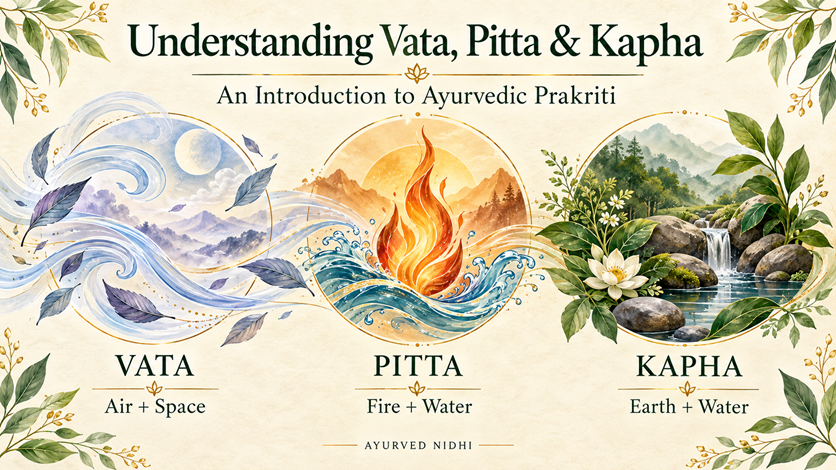
The three Doshas—Vata, Pitta and Kapha— are central to this traditional explanation. They are described in terms of patterns and qualities rather than as three measurable substances circulating in the body.
Vata: movement and variability
Vata is conventionally associated with Vayu (air) and Akasha (space), and with qualities such as lightness, dryness, coldness, subtlety and mobility. In traditional teaching it helps describe movement-related functions and changing patterns. A person describing irregular daily habits, variable appetite or disrupted sleep may hear a practitioner discuss Vata as an interpretive concept. Those complaints still need ordinary clinical assessment where appropriate.
A practical discussion might focus on regular meal and sleep times, comfortable activity, sufficient nutrition and avoiding extreme changes in routine. These are not treatments for a supposed laboratory-confirmed “Vata disorder.”
Pitta: transformation and heat
Pitta is traditionally connected with Agni (fire) and Jala (water), and qualities including warmth, sharpness and fluidity. Ayurveda uses the concept when discussing transformation, appetite and other patterns. People should not interpret “high Pitta” as a diagnosis of gastritis, liver disease, inflammation or hormonal imbalance.
Questions about meal timing, dietary triggers, working conditions and irritability can be helpful in a consultation, but persistent pain, vomiting, jaundice, fever or other concerning symptoms need medical evaluation.
Kapha: structure and stability
Kapha is traditionally linked with Jala (water) and Prithvi (earth), and with qualities including heaviness, coolness, softness, stability and unctuousness. It is used to discuss maintenance and steadiness within the Ayurvedic framework. It should not be equated automatically with obesity, hypothyroidism or a specific metabolic disease.
A thoughtful conversation may explore realistic movement habits, adequate sleep, balanced meals and personal circumstances rather than relying on stereotypes about body type.
Is everyone only one Dosha?
No. Traditional texts and teaching describe people with single-Dosha predominance, dual-Dosha tendencies and relatively balanced constitutions. Ayurvedic Prakruti generally refers to an enduring constitutional interpretation, whereas Vikriti refers to a practitioner’s assessment of the current state or departure from that baseline. Different traditions and practitioners may apply these ideas differently.
Can a quiz determine my Prakruti / Prakriti?
Online quizzes can be useful conversation starters, but short questionnaires often simplify nuanced concepts. Their results should not be treated as medically validated diagnoses. A consultation may involve questions about long-standing tendencies and present changes; the practitioner should also recognize limitations of the method and consider established medical findings.
How Ayurvedic Prakruti fits into a responsible consultation
The practical value of the conversation is often in becoming more aware of patterns: meals, sleep, movement, stress, personal preferences and sustainable habits. Any guidance should respect age, medical conditions, medications, pregnancy status, cultural food preferences and the patient’s actual circumstances.
Ayurveda may involve diet, lifestyle and products, but rigorous research on many Ayurvedic interventions remains limited. Some preparations have safety concerns, including heavy-metal contamination. NCCIH’s overview provides a useful evidence and safety perspective.
Frequently asked questions
Are Vata, Pitta and Kapha the same as body types?
Not exactly. They are traditional explanatory categories that encompass more than appearance, and they are not established medical diagnostic categories.
Can my Dosha change over time?
In traditional language, Prakruti/prakriti is usually considered relatively stable, while current patterns or Vikriti can vary. Neither concept replaces evaluation of new symptoms.
Should I follow a strict Dosha diet from the internet?
Avoid restrictive diets based solely on a quiz. Nutrition should be adequate, culturally practical and adjusted for medical needs, allergies and any prescribed treatment.
Can Ayurveda identify the cause of a medical condition through Prakriti alone?
No. A traditional constitutional discussion cannot establish the medical cause of symptoms; appropriate examination and testing may be needed.
Discuss your constitution with a physician
If you are interested in understanding Ayurvedic Prakruti as part of an individualized Ayurveda discussion, explore the doctors’ backgrounds on Our Doctors and proceed to Book Online Consultation. Suitability and local requirements should be confirmed by the clinic.
Educational note: Traditional Ayurvedic concepts are described for understanding, not as substitutes for medical diagnosis or treatment.